
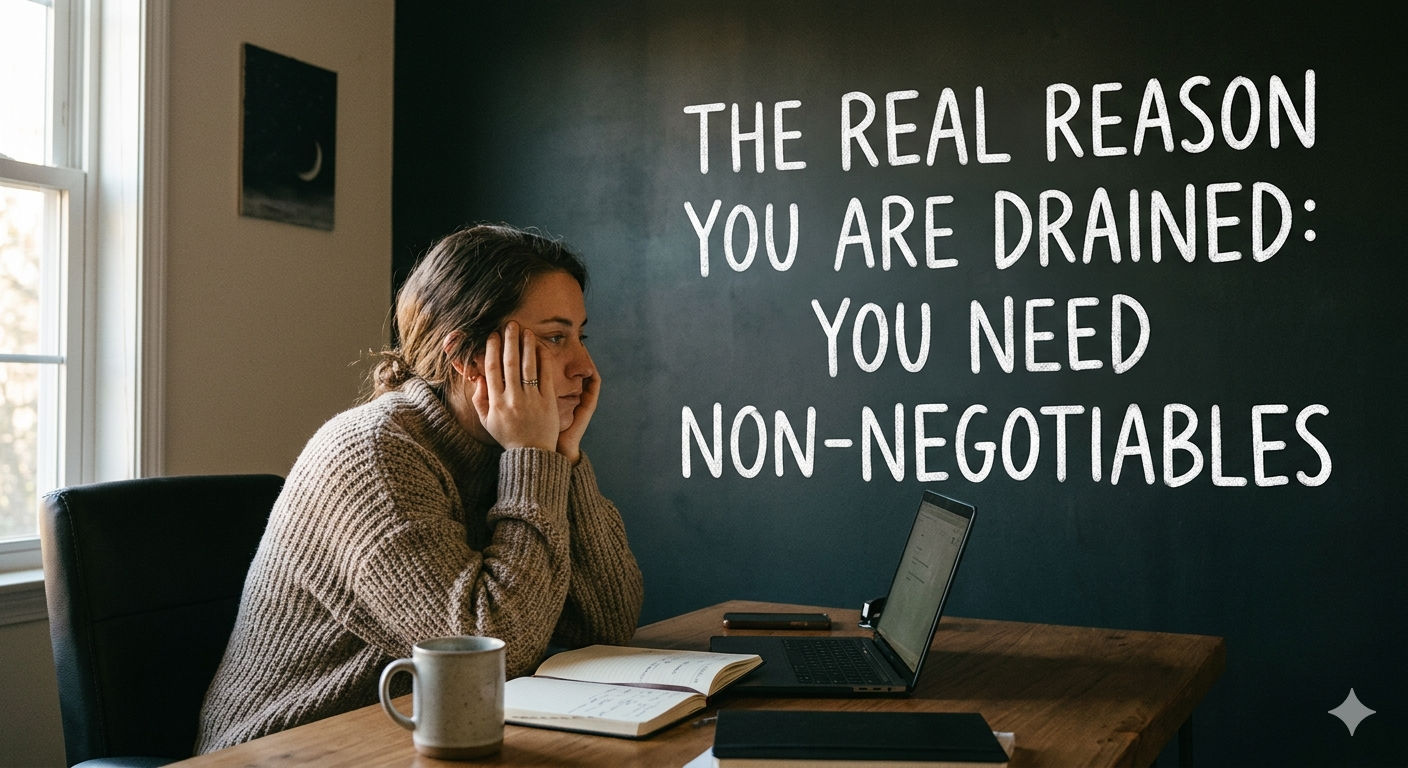
People-pleaser?: What Are “Non-negotiables?” & Why You Should Have Them
If you’ve spent years saying yes when you wanted to say no, rearranging your life for people who wouldn’t do the same, or swallowing your discomfort to “keep the peace,” you’re not being kind, you’re being a people‑pleaser.
People‑pleasing is what happens when you don’t have non‑negotiables.
Non-negotiable are your standards. They can be a spoken or unspoken set of boundaries.
Non-negotiables are your rules to live by and code. It is important to make non-negotiables clear to yourself and others to avoid being a people-pleaser.
Non-negotiables protect your time, energy, and self‑respect. Without them, you slip into people‑pleasing and people pleasing leads to doing things that drain you, agreeing to things you don’t want, and tolerating behavior that hurts you.
People-Pleasing Explained:
Being a people-pleaser may not sound negative to some people. How is pleasing people BAD?
The term “people-pleaser” is when you are bending over backwards to please people at your expense. You may be silent when something bothers you.
You try to be the better person and let things slide.
You continue to do this over and over til it becomes a pattern with individual relationships.
You may have expectations for relationships and never voice any disappointment like the times they were very late.
Your friends may ask you to make plans last minute or ask for help last minute and you say yes.
They may ask you to bring something to an event that you don’t even want to go to.
Not speaking up can lead to becoming a “people-pleaser” and leads to resentment.
It is not bad to say yes to last minute plans or help at events.
The problem happens when you do not have your own “non-negotiables” and you do not speak up or set boundaries.
Signs of People Pleasing:
– You stay silent to avoid conflict
– You let things slide to “be the bigger person”
– You say yes when you want to say no
– You accept last‑minute plans
– You tolerate lateness
– You don’t express disappointment
Examples of Non-Negotiable Mental Scripts You Can Use and Examples
(and later in the article, there will be examples of how to deal with them):
Time and Scheduling Boundaries:
- “I do not rearrange my life for people who cannot meet me halfway.” Example: making plans at a time that inconviences you just because it is convenient for them. This could also be with business appointments.
- “I do not need to be more flexible. I need to be more aligned with myself.”
Example: Not waiting more than 15 minutes if someone is late.
Attending an event that you are not comfortable going when you do not really want to go where there are no personal reasons for you to go except the benefits of someone else.
Scheduling appointments with clients or friends that are not aligned with the schedule and times that are best for you (again).
- “Don’t drain yourself for “maybe plans” or late plans.”
Example: Waiting around to see if it is a yes instead of living your life and doing something else you want to do.
- “If making plans disrupts regulation, change how you plan.”
Example: A solution to this can be changing how you plan where you set an end time, ahead of time for when appointments are expected to end.
- “I plan my social time around my life. Not my life around social time.”
Example: Not skipping the gym or a run to see a friend. Keep your routine. It may seem harmless to miss your own habits one time to meet a friend, but it is not because it says to your subconscious and yourself that your own goals are not that important.
It also can cause a habit of missing showing up for yourself. It also makes a sense of sacrifice happen when you are sacrificing your ‘me time’ or fitness to see a friend or an appointment and that can lead to resentment.
You can show up for yourself and find a different time for them. Your future self will thank you.
A non-negotiable here is anything having to do with health, family, or business is prioririty and then hobbies and fun plans get scheduled at a different time so they do not interfere with your goals, business, and family.
- If someone wants to change the time or meeting place the day of, or the day before, and if it inconviences you or you do not like it, they may always keep trying to shift appointments. You can say you are not available (or not available earlier or later) and ask them another day and time that may work.
Sometimes we say yes because scheduling it was so difficult in the first place, but doing so teaches them that you do not have time boundaries and they will try to do this over and over again.
Sometimes it is necessary to say, “I scheduled to fit you in at this time and in the future, I will not be available to shift the time earlier or later with short notice due to what I already schedule when I plan my day.”
More Scripts for Scheduling Boundaries:
– “I don’t wait longer than 10–15 minutes, so I’ll head out if you’re running behind.”
– “Last‑minute plans don’t work for me, but thank you for thinking of me.”
– “I can’t shift my schedule today, but I hope it goes well.”
– “I am unable to take on more at this time.”
Emotional Boundaries:
- “Compatibility matters more than niceness.”
Example: Speak boundaries when someone does something you do not like. If they do it once, they will think it is okay and may continue doing it. The key is learning to kindly express your need without blaming or embarrassing them.
Script: “I value being on time. If we’re meeting, I need us to be on time, otherwise I cannot do it.” Or “I need to cancel. Today isn’t working for me anymore” (if they are super late). Protect your time. You matter too and have things to do.
Any time something upsets you, gives you anxiety, or is making you have dread or any other negative feeling, it is your inner voice telling you that there is a boundary broken or a boundary that needs to be set.
The boundary is what will protect you from their behavior and you will find those feelings of anxiety, dread, or resentment will fade away if they respect your boundaries in the future.
Scripts for People Who Push or Guilt‑Trip:
– “I’ve already given my answer. It’s still no.” (A bit firmer, but for people who are haggling you.)
– “I don’t do things out of guilt. If I say yes, it’s because I genuinely want to.”
– “I’m not changing my mind, but thank you for understanding.”
– “I don’t have the capacity for that.”
I do not accept “Bread-crumbing”:
- “I do not accept breadcrumbs.” You don’t say that directly to someone, but it can be your non-negotiable.
A breadcrumb is where someone gives you a tiny burst of attention then goes unresponsive. Maybe they never respond to your replies and then later send another message unrelated to the last conversation. They give small signs of communication or attention like, “Thinking of you,” but never have a short conversation with you. This is a breadcrumb when it happens all of the time and is missing the real conversation. It could be saying, “I hope you are doing well” and then a week later sending a meme or a reel, but never really engaging with you on a human level.
This may seem harmless and have good intentions. However, over time they give the message they are too busy for you, you do not matter, and can make you feel unheard and left unseen.
This happens in dating too where someone keeps you interested just enough to leave you as an option, but rarely or never makes plans for a date.
Accepting breadcrumbs harms your self respect and makes you wonder if something is wrong with you that they do not reply in a way that follows up with their questions or responds to what you said.
One-sided relationships breadcrumb. You can make space in your schedule by setting boundaries with these dynamics or cutting them out and that leaves your time available for recipricol relationships.
Accepting bread-crumbing just makes you feel bad about yourself.
Scripts for Breadcrumbing (friends or dating):
– “I prefer consistent communication, so this pattern doesn’t work for me.”
– “If you want to make plans, let me know. Otherwise I’m moving on with my week.”
– “I’m not available for on‑and‑off attention.”
– “I need real conversations, not just check‑ins.”
– “When you ask me a question and I answer, I expect a reply and not to be left ‘on read.’”
Integrity Boundaries:
- “I will not do anything dishonest because someone asked me to,” (and said, “Don’t worry, no one will know and it will help me out a lot.”).
– “I’m not comfortable with that, so I’m going to pass.”
– “That doesn’t work for me, but I appreciate you asking.”
– “I’m not available for that kind of conversation right now.”
– “I hear you, but I’m not taking that on.”
Scripts for Protecting Your Energy:
– “I’m keeping my day low‑stress, so I’m not adding anything else.”
– “I’m choosing rest today.”
– “I’m not taking on anything extra right now.”
– “I’m staying aligned with what I need today.”
Being accomodating does not protect you or make you kind. It makes you easier to dismiss. It makes it easier for someone to walk over you.
The reason we are accomodating or over-accomodating is: we try to be the nice friend and the understanding one.
Doing this one time seems harmless, but it establishes a baseline and leads to patterns in relationships.
Be true to yourself and your ideal situations.
I heard the advice of “only accepting your ideal makes space in your life for your ideal” meaning if you are not available for the shallow friendships, breadcrumbing romantic partners, then you make space and time for new people to enter your life that will be there for you or your true love.
Being accommodating doesn’t protect you… it erases you.
A relationship means to relate to one another. This goes both ways. They need to relate to you. They need to be recipricol in responses and scheduling. They need to learn to love you in the way that makes you feel loved and not in the way that is convenient for them to love you.
Non‑negotiables aren’t rigid rules; they’re self‑respect in action.
When you stop accepting crumbs, you make space for people who offer the whole loaf.
People‑pleasing is what happens when you don’t have a clear code for how you want to be treated.
Your non‑negotiables are not “rules for other people.” They are standards for you and the way you protect your time, energy, peace, and self‑respect.
When you stop rearranging your life for people who wouldn’t do the same, you stop abandoning yourself.
Stop accepting breadcrumbs and you will make space for real connection.
When you no longer tolerate lateness, inconsistency, and disrespect, you create a life that feels calm, predictable, and aligned.
Non‑negotiables aren’t rigid. They’re grounding.
They teach people what version of you they get access to.
The moment you start honoring your boundaries and set non-negotiables, your life becomes quieter, clearer, and more honest because you finally stop betraying yourself to keep the peace.
If you would like to read more on friendships read next: How to Be a Better Friend: Are Your Friendships Mismatched?


thanks for info.