By Jill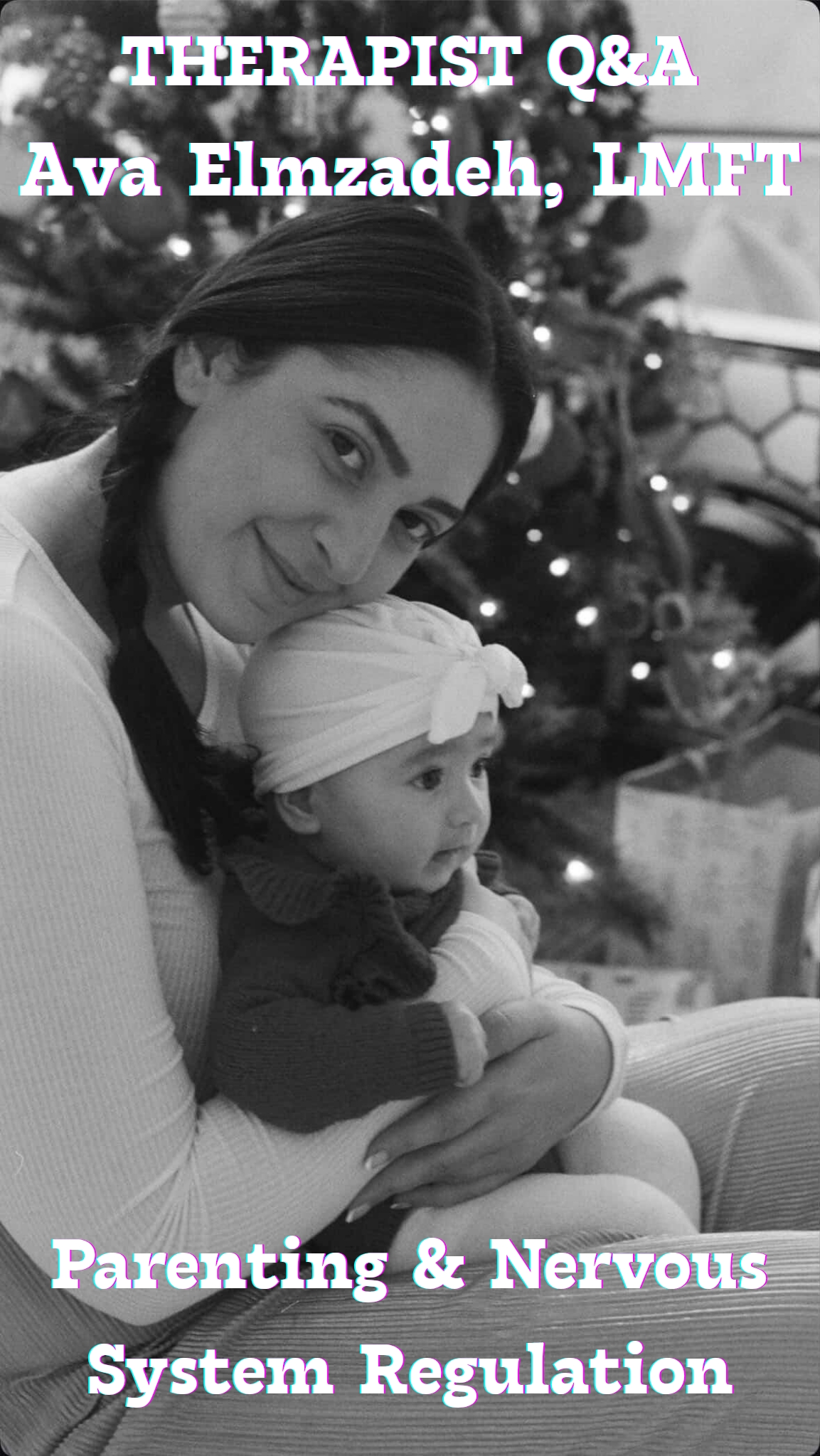
Q&A With Therapist, Ava Elmzadeh, LMFT & Professor
Learn how to Calm You & Your Babys’ Nervous Systems, Form Secure Attachment Through Language and Mirroring
This Q&A is to help readers understand how the various stages of child development affect parenting. We discuss child developmental stages and what to do for each stage, nervous system regulation, mirroring, co-regulation, resources for new parents, and how to face overwhelm as a new parent.
Disclaimer: This interview is for educational and personal insight only and is not clinical, therapeutic, or parenting advice.
Ava Elmzadeh is sharing what she does as a parent who is also a psychotherapist. This article is here to give grounded insights into early childhood development, emotional connection, and everyday parenting challenges. It is meant to offer clarity, not prescriptions for parenting and the goal is for parents to feel more supported and informed as they navigate the early years of parenting.
Ava Elmzadeh, MA, LMFT, is a licensed Marriage and Family Therapist based in Irvine, California. She holds a Master’s degree in Clinical Psychology from Pepperdine University, where she now serves as an Adjunct Professor.
With over eight years of experience as a therapist, Ava specializes in anxiety, stress, life transitions, and identity exploration and supporting young adults navigating adulthood. Her therapeutic style is collaborative, culturally sensitive, and rooted in Collaborative and Narrative approaches, helping clients reconnect with meaning and move toward lives aligned with their values. Ava is passionate about helping clients rediscover their stories and move toward lives aligned with their values and hopes.
Q&A With Ava Elmzadeh, LMFT & Professor:
How has being a therapist influenced the way you approach parenting, especially in the early months?
Ava Elmzadeh:
“Knowing that there is a wealth of knowledge out there about child development has been helpful in knowing what to do based on the child’s age. For instance, newborns are born with underdeveloped color vision and cannot see far, so from day one at home, we started reading books to the baby. The books were black and white large images of animals and such. I also knew to come close to the baby and sing to the baby as that was a wonderful way to connect.”
Inspired Self Blog: Finding books, YouTube channels, and advice on each stage/age of your child’s development can give you helpful tips in navigating your child’s changes.
Listed below is each age and different stages of brain and emotional development.
Understanding these stages can help your child to better understand your parenting and communication:
0-3 months- The Regulation Stage
Babies are learning to adjust to the world: sleep, feeding, soothing and bonding.
Emotional insight: Babies borrow your nervous system, so staying calm and responsive helps them learn what safety feels like.
6-9 months- The Exploration Stage
Babies begin sitting, crawling, grabbing objects and showing curiosity.
Emotional insight: Letting them explore while staying close teaches them independence is safe when a caregiver is reliably nearby.
9-12 months- The Communication Stage
Babies point, gesture, babble, and understand simple words.
Emotional insight: Labeling their emotions (“You’re frustrated because the toy fell) helps them feel understood and builds emotional vocabulary.
12-18 months- The Big Feelings Stage
Toddlers walk, test limits, and express strong emotions without language.
Emotional insight: Co-regulation, staying calm, validating feelings, and offering comfort teaches them how to manage overwhelm.
18-24 months- The Autonomy Stage
Toddlers want independence, they begin to make choices, and say “no” often.
Emotional insight: Offering simple choices i.e. “red cup or blue cup” reduces power struggles and supports healthy autonomy.
2-3 years- The Identity & Language Boom
Toddlers develop language rapidly, imitate adults, and show preferences.
Emotional insight: Mirroring their words or actions helps them feel understood and strengthens the connection.
3-5 years- The Social-Emotional Stage
Preschoolers learn empathy, sharing, imagination, and early problem-solving.
Emotional insight: Modeling calm, problem-solving teaches them how to navigate conflict without shame or fear.
Secure attachment is formed ages: 0-12 months
Co-regulation: 12-36 months
Language mirroring: 1-3 years
Avoiding screens: Age 0-3 years old
Understanding cues: All ages especially 12 months
Managing overwhelm as a parent: Every age of your child into adulthood
What surprised you most about becoming a parent, even with your background in mental health?
Here Ava Elmzadeh explains how emotional regulation helps parenting along with tuning into a child’s cues. Parents need to be gentle with themselves as they adjust to having a baby.
Ava Elmzadeh: “People warn you about how difficult it is to raise a baby, but I didn’t know it would be this hard. Waking up every 2-3 hours in the middle of the night to feed a newborn while healing my body was the toughest challenge of my life so far. It is temporary, which I reminded myself, so I tried to show up the best I could.”
Inspired Self Blog: Find ways to emotionally regulate yourself. For example, inhale to the count of 4 hold to the count of 4 exhale to the count of 4 or make your exhale longer than your inhale to calm your nervous system even more.
Make sure you take time to eat and take care of yourself.
It is difficult to be a parent, even with a background in therapy.
Studies have found that short journaling sessions, where you write out your frustrations, can reduce stress. You can get your emotions out on paper.
Holding in our emotions can lead to exploding, overwhelm, and can even harm the body over time due to stress.
Exercise, walks, and journaling are healthy ways to release stress and emotions from the body. You can take your baby on a walk and both enjoy fresh air.
Your best will look different each day, depending on how tired or overwhelmed you are. Some days you may just sleep between every time your baby eats and sleeps. Other days you may have more energy for self care.
Are there therapeutic tools or frameworks you use in your own parenting, like grounding techniques or boundary modeling?
Ava Elmzadeh: “Some ideas I like to engage with are: knowing that each child is unique and to learn from the child as they will show you what they need. To be a good listener.
One tool I like to use for myself to regulate my emotions is to take breaks, get some fresh air and hydrate. Taking care of myself even for one minute makes a difference for me.”
Inspired Self Blog: Examples of grounding techniques are naming in your mind 4 things you see, 3 things you hear, 2 things you can touch, 1 smell or any combination of engaging your sensations to turn off emotional overwhelm.
Breathwork is another example of grounding that was mentioned earlier in this article.
How do you balance your own emotional bandwidth while supporting your child’s needs? What tips can you give to new parents?
Ava Elmzadeh:
“I was very lucky to be a new parent and also have another parent to step in when I needed a break. It’s a great privilege to not do this alone.
I think creating structural support around the tiredness, frustration or anxiety was helpful. Instead of focusing on the problems head on.”
Inspired Self Blog: Find the support of other parents, especially if you are a single parent. Join online parenting forums. You can join meet up groups for new parents or mommy and me classes. These groups will help you find new friends that are going through parenting alongside you so you do not have to do everything alone.
Make sure to discuss with your doctor if you have feelings of overwhelm and they can suggest alternative solutions for you.
Delegate parenting tasks with your co-parent by taking turns, discussing routines or schedules, and finding ways to reduce overwhelm together.
What do you wish more new parents understood about infant emotional development or nervous system regulation?
Ava Elmzadeh: “Do not yell at children of any age because it creates distrust and dysregulation of the nervous system.
Also, to know that children are not manipulating you- this is a common one I hear. Children aren’t attention-seeking, noisy beings. They are curious and crave connection. If they don’t fear you, they will test limits, which is normal.”
Inspired Self Blog: You want to create an emotionally safe environment for your child to develop a healthy nervous system. Being present with your child in the moment by making eye contact, speaking in a soothing voice, and coming when your child cries helps reinforce the development of a healthy nervous system.
What are your favorite parenting resources e.g. books, podcasts, or resources that you find helpful for parenting?
Ava: “I really enjoy Emily Osters work including her instagram Q&A’s on Wednesdays and her books on pregnancy and parenting.
Inspired Self Blog:
Emily Oster’s Parent Data 3 Book Series (As an amazon associate, I earn from qualifying purchases):
Emily Oster’s Website:
Ava: Parenting.org has great articles.
Also, interviewing (observing) your own children on what works for them is invaluable.”
Inspired Self Blog: What Ava means by “interviewing” your child is to observe how they respond to different tones of voice, facial expressions, and routines. You observe and decode your child based on their behavioral cues. Notice what soothes them (rocking, singing, quiet, or movement).
Track patterns: when they reach from you vs. pulling away or when they cry and what helps them settle
Treat their reactions as answers for what works for your child.
How do you navigate moments of overwhelm or doubt as a parent, especially when your therapist brain kicks in?
Ava: “Something I learned from Gottman (the authors and research psychologists of Marriage and Families) is the idea of maintaining 5 positive interactions to one corrective interaction with your child.
Numbers and statistics (Creating 5 positive interactions for every 1 negative interaction) help me understand how the relationship is going instead of listening to the shame/guilt voice in my head.
I also try to practice gratitude every day and mindfulness to be present with her and our family.
Overwhelm is also normal to feel because babies and toddlers take a lot of work to take care of and we still have jobs and need to pay the bills.
I try not to fall too deeply into mom-guilt and shame thoughts. I know very well how strong those ideas are and how deceiving they can be.”
Inspired Self Blog: Gottman Books for more information:
“Raising an Emotionally Intelligent Child,” by John M. Gottman.
Books on Shame/Guilt:
“I Thought It Was Just Me (But It Isn’t): Telling the Truth about Perfectionism, Inadequacy, and Power,” by Brene Brown
“Daring Greatly,” by Brene Brown.
“The Gifts of Imperfection,” by Brene Brown.
Brene Brown is a shame researcher and Inspired Self Blog highly recommends her books.
Programs:
“Bringing Baby Home” (Gottman program for new parents). We are not affiliated/sponsored by Gottman.
Gottman Parenting Platform videos, exercises, guides) Link Below:
https://www.gottman.com/parenting/
What’s one therapeutic insight that’s helped you most in building connection with your child?
Ava: “You don’t have to be a perfect parent. There is way too much advice out there on what to do and not do- but just focus on the big things like not yelling, no violence and prioritizing the partner/parent relationship as well so it doesn’t lead to divorce.”
Inspired Self Blog: Self regulating your emotions when you are overwhelmed is important for you, your baby, and your relationship with your partner. Find ways to not be reactive. This could be through breathing exercises, taking a step outside for fresh air for 30 seconds, taking time for self care even if it is brief, speaking up when overwhelmed, and asking for help from others.
How do you use language to connect with your child? What other ways do you connect? How do you use language to better describe what is happening and why is this important?
Ava: “Our daughter is learning two languages at once- Farsi and English. It’s been interesting speaking to her with both. We mostly speak to her and describe what she does while she plays, point out animals or objects and read 5-10 children’s books a day with her.”
Inspired Self Blog: Describing what she does while she plays helps her learn language and also can build self-awareness. Reading together and pointing at the words can help your child get a head start at learning to read.
If you could offer one piece of advice to new parents navigating emotional triggers or identity shifts, what would it be?
Ava: “Keep stressors low; say no to events, gatherings, familial expectations, work expectations, if possible. It is a sacrifice to prioritize a child’s well being, but it will be worth it if the child has a secure bond and feels loved and safe.
Also, short-term issues can lead to long-term affects. It might be difficult and tiring to set limits now, but in the long run it will be worth it.
For example, doing too much time spent with screens in the first three years can have effects on language, attention and other factors.”
Inspired Self Blog: Becoming a new parent is a big adjustment. Take the time you need to adjust and reduce extra tasks when possible. Do not overschedule yourself so you have time for self care and to spend with your baby.
How do you secure a bond and what is secure attachment and why is it important? How early do you start?
Ava: “A secure attachment allows for children to feel safe enough to explore their environments and know a safe caregiver is nearby. Some things not to do include: yelling, hitting, neglecting and abusing the child. This starts from day one because even small babies can read emotions and feed off of your emotions.” Ava also mentions being a secure base for her child by being stable and calm where she lets them go off and explore.
Inspired Self Blog: Any emotionally chaotic environment can leave a lasting impression on a child, even though they may not remember what happened, it leaves an imprint on their nervous systems. Giving your child a sense of safety and knowing they can trust and rely on their parents sets them up to develop a secure attachment style for the future.
What is co-regulation and how does it help toddlers?
Ava: “The way I like to think about co-regulation is that it is my responsibility as a parent to stay calm and acknowledge how my toddler feels. Co-regulating happens when you verbally express how a toddler finds something sad or frustrating, validating them and maybe hugging them and breathing together.”
Inspired Self Blog: Co-regulating is when a parent calms themselves and their child at the same time and prioritizes their child’s emotional well-being.
Ava also mentioned tailoring your parenting to your child’s individual temperament and personality when possible.
Why is it helpful to avoid screens? How early do you start avoiding screens and how long should they be avoided?
Ava: “Screens too early on can affect language and social skills development and attention. We didn’t do any screens except FaceTime for the first year and a half. Now we do 30 minutes on average a day of low-stim long form films/tv like Mr. Roger’s.”
Inspired Self Blog: The book, “The Anxious Generation,” by Jonathan Haidt goes into depth about how screens affect childhood development and teens and how a screen-based childhood can affect children’s abilities to develop social skills and ability to focus.
How do you redirect when your baby is frustrated?
Ava: “Redirection can be distracting them any way possible that is available to you including handing them a new toy, changing the environment or playing a game.”
What is mirroring and how can parents mirror their child? What are the benefits?
Ava: “Now that my child is 1.5 years old, she finds (me) mirroring her behaviors and language funny. I wish I could ask her how mirroring specifically benefits her (since she is young and can’t explain), but it seems to help them feel seen and heard.”
Inspired Self Blog:
Mirroring is when we “…mimic or mirror another person’s facial expressions, nonverbal behaviors, and verbal expressions. We engage in this behavior without even realizing that we are doing it,” Psychology Today: “The Chameleon Effect: Why We Mirror Friends and Lovers” by Suzanne Degges-White Ph.D. The benefits of mirroring are that it increases connection and bounding in relationships. Many studies have been done on mirroring and it is measurable in brain neurons.
16. When is the child’s brain developing the most and why is it important to know this and influence brain development as parents?
Ava: “The baby’s brain develops rapidly in the first three years- about 80% of brain development happens here and it is very crucial parents understand how important this growth is. Just because your baby may not remember the first three years, doesn’t mean it won’t impact them later on.”
In Conclusion, parenting in the early years is a blend of instinct, learning, and constant emotional adjustment. Ava’s insights remind us that children don’t need perfection — they need presence, safety, and caregivers who are willing to grow alongside them. Whether it’s co-regulating through big feelings, understanding developmental stages, or simply slowing down to connect, small moments shape a child’s nervous system and sense of self. As you move through your own parenting journey, take what resonates, trust your intuition, and remember that your steadiness, not your flawlessness, is what builds secure attachment and lifelong emotional health.
If this piece resonated, you can explore more writing on InspiredSelf.blog.
Sources:
National Library of Medicine: “Modulations of mirroring activity by desire for social connection and relevance of movement,” https://pmc.ncbi.nlm.nih.gov/articles/PMC4221217/
Psychology Today: “The Chameleon Effect: Why We Mirror Friends and Lovers” by Suzanne Degges-White Ph.D. https://www.psychologytoday.com/us/blog/lifetime-connections/202312/the-chameleon-effect-why-we-mirror-friends-and-lovers.
Experiencing Overwhelm? Discover these tips here: