Most of us are not taught much about emotions. It should be something taught in school. That can leave us as adults, wondering what we are feeling. I realized in 2019, I didn’t know what I was feeling. Emotions felt like an intrusion. I didn’t want to have them.
In order to feel balanced and happy, we need to know that emotions are a guidance system and know how to use them. They can tell us what is going well and what to continue in our lives and what isn’t working, needs a change, or solution.
In order to use our emotions to our advantage, we first need to know how to identify them. Some of us, like me in 2019, did not know what I was feeling or why. I just felt uncomfortable. If this is you, below are my steps of what helped me learn how to identify emotions and then use them as a tool to help me create the ideal life I want and feel good daily.
Steps to Discovering Your Emotions:
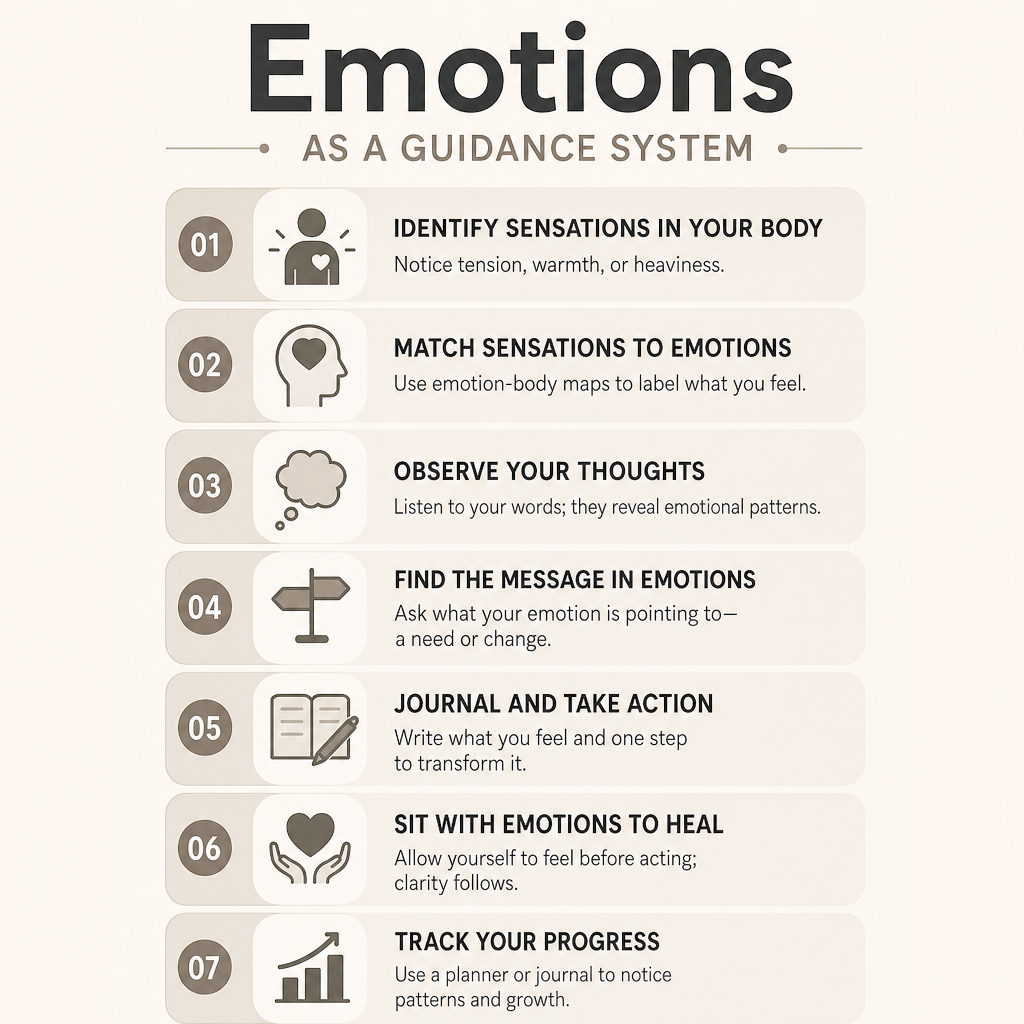
1. Learn to Identity Your Emotions by Feeling What Part of Your Body Has a Sensation:
If you are not able to identify your emotions, they can still be detected as sensation in the body.
Research has shown across multiple cultures that there are predictible locations where emotions manifest in the body.
If you are not in touch with them, then first think of where in your body you feel something. It may be a tightness in the throat or stomach, or heat.
Below is a list of each region of the body and the sensation according to somatic-emotion mapping research:
Anger: heat and activation in the arms, chest, hands, and face. It could feel like an upward, rising energy from the abdomen. Your face may turn red and hot.
Anxiety: a tight chest, a “fluttery” feeling in the stomach like “butterflies” or a tense stomach, nausea, cold hands or feet, a tight throat, or a “jittery” feeling.
Sadness: Heaviness in the chest, a lump in the throat, low energy especially in the limbs.
Fear: Wanting to escape, run or leave. It may be felt in the chest, stomach, or legs wanting to make you move.
Guilt: Pressure in the chest, throat, and sometimes stomach discomfort and sometimes a heaviness or dread.
Love: Warmness in the chest or face, relaxed feeling, sometimes a soft face. Love varies more culturally than the other emotions in large-scale research.
Numbness: Deactivation in the limbs, calm chest, “blank” feeling.
Calm: Warm, eveness, low-activation of sensations across the torso and body.
Joy: Energy, lightness, a warmth in the chest, a readiness to move or bounce, and joy activates smiling and face warmth.
2. Look up a list of possible emotions and where they show in the body. There are long lists with more specific emotions than the main emotions listed here.
Try to label what emotion your physical sensation is pointing to. Decide if that emotion seems accurate for how you are feeling. You want to decide what emotion you think it is you are experiencing.
3. What thoughts are you having that could relate to your emotion? If you are unsure of your thoughts, listen to what you say out loud to people and what you talk about.
4. What does your emotion point to? Is there a problem to solve? Something to change?
Something that helped me was when I was worried about my Grandpa or Dad’s health, I couldn’t control their health, but the action step I took was calling them. I could at least check in with them and see how they are doing and that helped settle some of my emotions.
Positive emotions point to what we desire, want to continue, and what is working for us.
5. Label the emotion
Journal on it by writing what you feel, possible reasons why you may have that emotion.
Then write 1 or 2 action steps of changes you can try to transform your emotion (what can you do about this situation).
Does it tell you something?
Is there a boundary to set?
What needs to stop, start, or change, or continue in order to make you feel better?
How Can You Heal Your Emotions?
Sometimes you need to sit with an emotion and really feel it. You need to do this in order to heal it or before it can go away. This may be uncomfortable.
After sitting with it, the action steps you decide on can become your plan. Your action steps are an experiment that you try. You see if it helps over time to solve the problem or make the emotion stop showing up.
See if you can schedule to do the new action daily or weekly or it may require stopping an action depending on the emotion.
Check-in:
Journal, use a planner, track what you are trying to change and see how you feel over time. Journaling briefly every day can help you understand your emotions and learn how to use them to guide you and make changes rather than feeling uncomfortable feelings and not knowing why.
Every emotion is information you can use to transform your life one choice at a time.