By Jill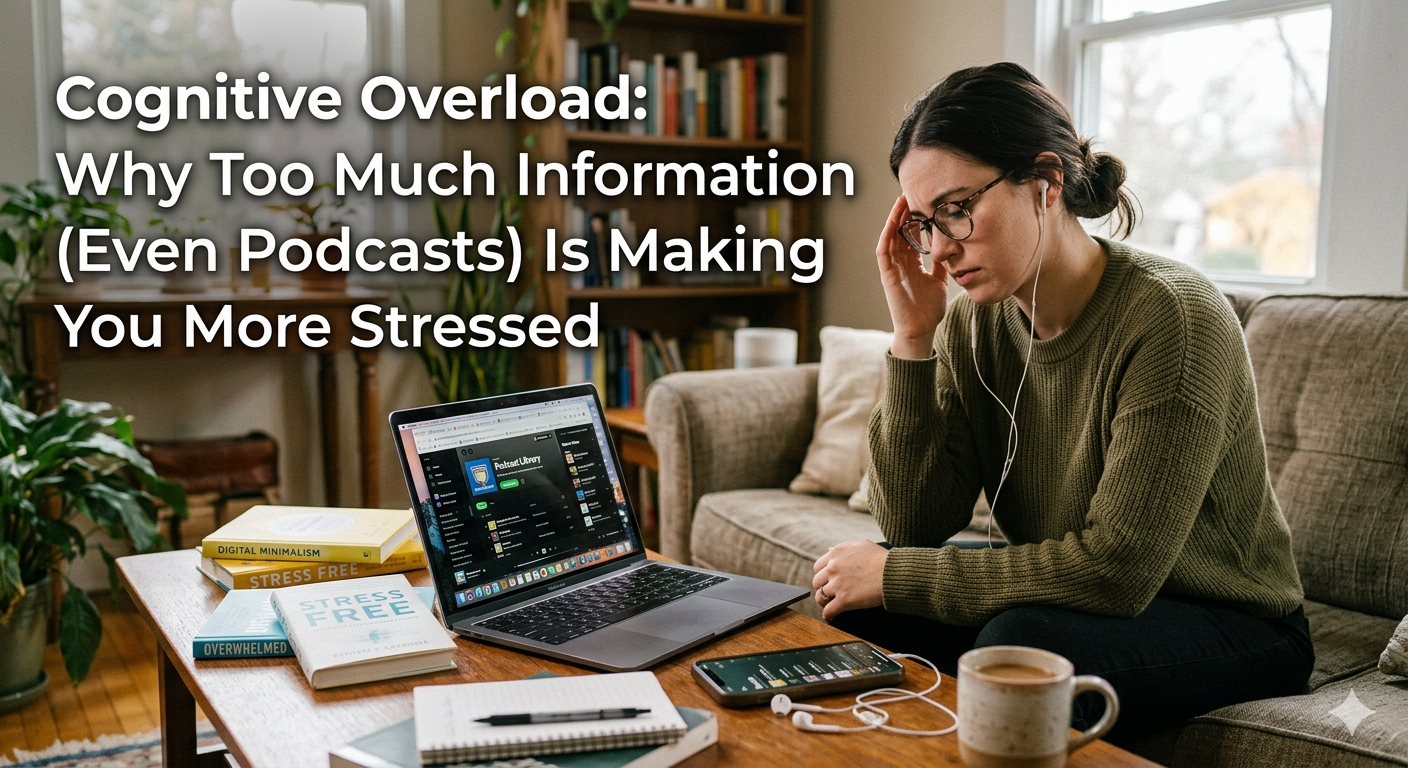
What is “Cognitive Overload?” Below we will discuss what it is and 6 Causes of Cognitive Overload & 5 Tools You Can Try if You Are Overwhelmed
I heard the terms “information paralysis” and “analysis paralysis.” It is where we gather so much information and do not act on it.
You may be overloaded from too much information.
We usually equate gathering information as self improvement or a positive activity, but what if it is making you tired?
There is a hidden cost of constant podcasts, audiobooks, and consuming information. It is called, “cognitive overload.”
Cognitive overload is where you are given too much information to process and too many simultaneous tasks akin to too many tabs open in your browser. This can lead to feeling unable to process or internalize the information, mental fatigue, inability to take action, inability to perform, or unable to remember all of the information that you would otherwise be able to utilitze if you were not overfed information.
Cognitive overload is where you are overwhelmed by tasks that you are normally comfortable doing.
We may not realize we have caused cognitive overload from intaking information. It is it’s own form of burnout.
6 Causes of Cognitive Overload:
1. Always having audio stimulation. Silence is good for your brain. It lets you process information. Silence also lets you be present and process your thoughts. When we are constantly listening to podcasts, audiobooks, YouTube, or even music, we can cause microstress on our brains. Usually these are positive activities, but if you are always listening to something in the background and you feel tired, you may have cognitive overload.
“Prolonged headphone use can disconnect you from your sensory environment and overwork your auditory system, leading to overstimulation and attention fatigue. This constant input limits your brain’s ability to enter restful, regenerative states.” —Kavin Mistry, MD quoted from HEALTH and the article, “13 Surprising Habits That Quietly Age You Faster” is referenced at the bottom of this article if you would like to read it.
2. Reading and specifically, reading that involves obtaining knowledge, facts, and information. Reading is relaxing, but when you are reading too much, too often, and overlapping tasks with reading, you can cause cognitive overload.
Overlapping tasks is when you try to watch something while also reading or listening to something while reading or other forms of multitasking.
3. Seeing too many emails, opening emails, and reading through multiple emails.
It is good to set limits on intaking information such as reading, podcasts, audiobooks, and tasks like emails by timing your activities and breaking them into smaller time blocks throughout the day.
Extended, long sessions of information followed by intaking information in another form will lead to burnout. A simple example is checking and responding to emails, followed by reading, and then followed by listening to a podcast.
Consider scheduling in some time for silence, sorting your thoughts, or contemplation of problem solving or internalizing of information.
4. Clutter can overwhelm you. Disorganization and seeing tons of objects around you makes your brain have to either ignore everything to focus, or concentrate to see specific things. Looking for something in a cluttered space wastes time and mental energy as you try to recall where it is and sort through a mess with frustration. Your phone and computer being cluttered with documents and photos can also contribute to this feeling.
5. Multitasking. Studies have proven that humans are not good multitaskers. Whenever the brain has to multitask, it shifts focus from one activity to the next. It is not focused on multiple activities at once. No matter how hard you try to multitask, it is less efficient than focusing on one task at a time and also produces better results to focus on only one task. Multitasking may be a side effect of being a parent or some jobs, but it can lead to cognitive overload.
As you continue reading, I have listed some ways to reduce and prevent cognitive overload below.
6. Decision fatigue: where you make too many small decisions, big decisions daily and eventually it leads to burnout. I have more articles on this topic and relieving overwhelm at the Posts & Articles Center on InspiredSelf.Blog.
5 Tools to Reduce Cognitive Overload:
1. Switching between different types of tasks can reduce mental fatigue and provide a break for the mind leading to increased productivity due to being able to focus longer without cognitive overload.
I like to do a task and switch to something else when I am tired of it or getting frustrated. Then when I come back to the task, I often feel refreshed or reinspired.
Try Scheduling a 5-10 Minute Break per every 1 hour of work.
Take a stretch break between tasks.
Taking regular breaks between tasks and information intake can help you process the information.
Give yourself time to contemplate on what you learned and make it permanent knowledge.
If you read or listen to something else immediately following hearing new information, it can overload your brain with information and makes it harder to remember what you learned. I noticed it may seem fine at first, but after frequently seeking information and immediately listening to something else afterwards and doing this for months, it can eventually lead to mental burnout.
What has helped me is:
having phone free times,
days where I do not listen to anything,
and days without reading books.
Then my mind feels refreshed and makes working inspiring instead of frustrating. I also find that after the breaks, I enjoy books and podcasts more than when I was taking in too much daily information.
2. Taking a walk to think is another way to process information. Simply think about what you learned on your walk. This can reduce stress and help you sort your thoughts.
3. The “pomodoro technique.” This is a technique where you set a timer for 15 minutes and focus on only one task. It can help you narrow your focus and be productive without multitasking.
4. Times of quiet help promote creativity, invention, new ideas, and inspiration.
Allowing yourself to be bored is not a bad thing.
Boredom can lead you to creative ideas and think up incredible things.
Some of the words most famous scientists and inventors spent much time thinking. Einstein even did who experiments in his head. Leaving time for quiet and boredom can lead you to new solutions.
When I grew up there were no smart phones. When we ate meals, we were either with our families talking, able to watch tv or read, or in silence. Many of my meals were spent in silence. Also going to the restroom, my friend had a basket of books. Without books, you were in the restroom in silence.
Moments of silence give our brains the breaks we need from the stimulation of the world and can lead us to invention and creativity. You may think you are not creative or this is not you or that you hate being bored. Every person has their own ideas. Being alone at times and having silence can help you transform and can change your life. We need small quiet moments every day.
5. Writing things down. Having a calendar and organizing your schedule where your phone or some system reminds you of your agenda helps you to not have to worry if you are forgetting something.
“A brain dump” is when you write down everything on your mind and can even list it, list your worries, or write anything and everything in your head. You can set a timer or do it until you can’t think of anything else to write. You can brain dump daily, in the morning for stress relief, or once a week, or whenever you feel overwhelmed.
In conclusion, if you feel uninspired, overwhelmed, tired, having trouble remembering things, having trouble making decisions, or frustrated frequently, you may be experiencing cognitive overload.
You may find that silence, simplifying your life, or trying some of the suggestions in this article can help reduce your symptoms of cognitive overload.
If you would like more help in reducing overwhelm, read this next: Stop Negative Thoughts: Use These Pattern Interrupts to Stop Overwhelm
or
What Does it Mean to “Let Yourself Go” & What to Do About it?
Sources:
1. Health: “13 Surprising Habits That Quietly Age You Faster,” by Sherri Gordon, https://www.health.com/habits-