
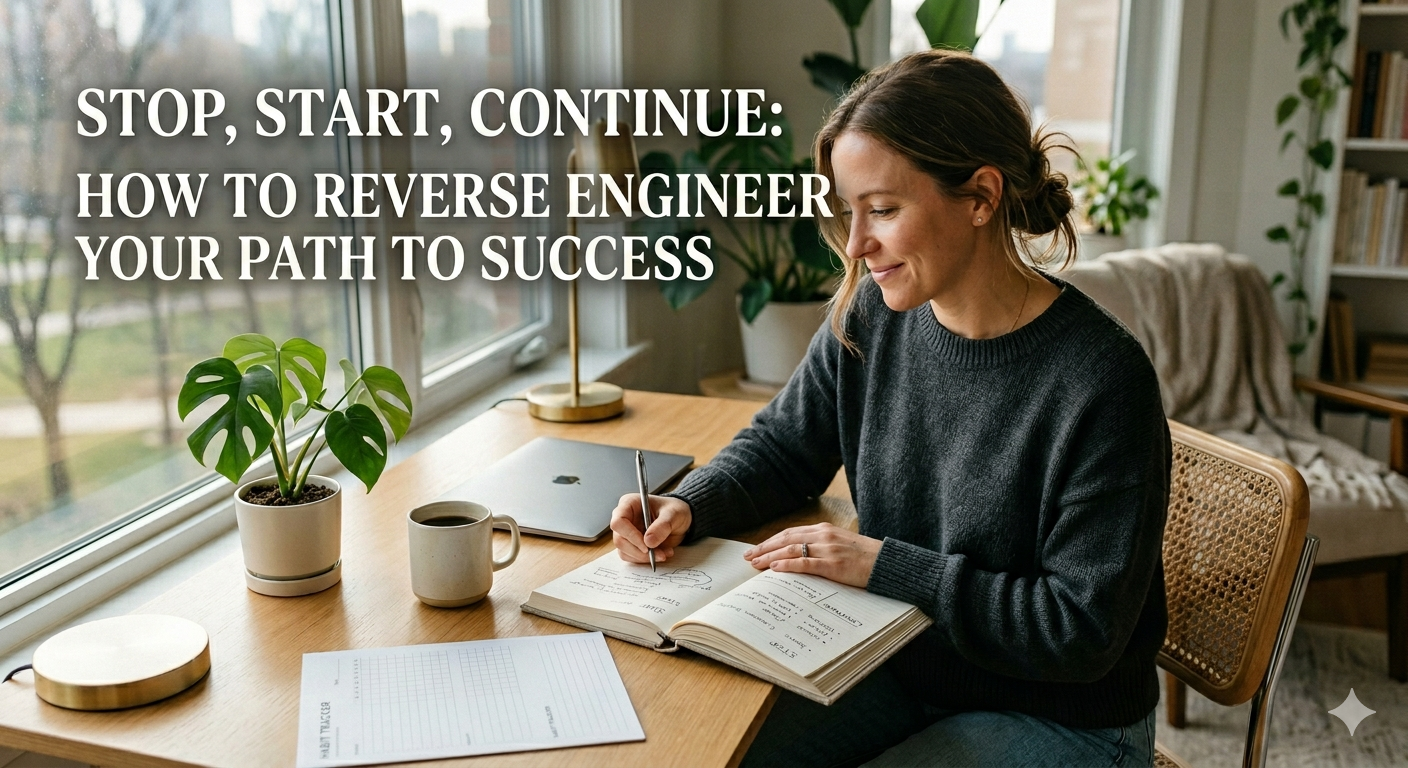
Stop, Start, Continue
We can shape ourselves, our identity, and our reality by noticing what we need to start doing, stop doing, and continue doing to reach our goals. This article will give examples and thoughtful questions to help you notice what to Stop, Start, and Continue to reach your goals.
Determine what you need to do to get there:
The best way to reach goals is to make them clear, track progress regularly, but most of all, you need to determine where you need to go.
You can reverse engineer the pathway to reaching your goals by thinking of the steps that would lead to the end result. Work your way backwards.
The steps are determined by your destination, the arrival point of where you will be when you reach your goals.
We set our own standards and actions we need to take to move towards our goals.
What do you need to start doing?
What is the simplest step you can take from where you are now? One step often leads to the next step or makes what is next become clear.
Can you write out all of the steps required and focus on small, daily actions?
Are there new habits you need to make?
For example, the identity of a “marathoner” or “writer” shows up every day to run or to write and plans their runs and writing.
You can become the new version of your desired self by simply showing up to do what that version of you would do. When I started running, it was very hard and I was slow. I showed up with a schedule, 3 days a week and progressed over time to 4 days a week. After months I added another day until I ran 6 days a week. I kept showing up, even though I was very slow and not good at running. By showing up consistently, over time, you become what you desire to be.
Being fit requires you to think and act in the way you would if you already were fit. That might mean planning meals ahead of time to make sure you get all of your daily nutrition, knowing what exact time you will fit in your daily workouts, and making time for recovery.
When we schedule an activity ahead of time, then we have more chances of getting it done.
Habits are created by consistency. Our lives are shaped by our daily habits. Change your daily habits and you will change your life.
Every day adds up to the person you are becoming. Once a habit is established, it takes away the need for motivation/will-power because the brain works differently with habits.
Habits become automatic and require less energy to continue than new activities that require willpower to begin.
What to Stop. What do you need to stop doing?
Stopping is often the hardest part because it requires honesty.
Ask yourself: What is quietly draining me or pulling me away from who I want to become?
Stop saying yes to everything that drains your energy and doesn’t feel fulfilling.
Stop habits that conflict with your goals or waste time or energy (e.g., skipping planning, procrastinating, endless scrolling on social media).
Discover what habits or patterns are keeping you stuck (e.g., perfectionism, comparing yourself to others, people-pleasing).
Stop commitments that no longer align with your goals.
For the marathoner, this could mean you stop staying up very late so you can fit in a morning run.
For the writer, it may be choosing to stop being a perfectionist by writing no matter what and editing later.
For the person seeking to be fit, this may mean pausing during meals, eating foods that are nutrient dense, and stopping eating habits you know may be interfering with reaching your goals.
It means you stop tolerating conditions or experiences that are not aligned with the end result identity or goal you have.
This could mean setting boundaries or making a life change.
You may need a new environment to help you flourish. This could be achieved by finding new, supportive communities, or joining a new gym, making new friends, or finding an accountability partner where you both check in to say if you made progress on your goals.
What are you tolerating in your daily life that is not what you would envision in your ideal life? What would be small steps to change this?
You don’t have to overhaul your life, just identify one thing that no longer serves you.
What do you need to continue doing?
What is working and going well?
What would be the daily task that would help you reach your goals? If you want to be a painter, schedule time to paint every day or nearly every day.
Make a Dedicated Space:
First start with making a space dedicated to your new goals so it is easy to set up and start.
A focus space helps musicians practice without distractions and helps researchers focus and research.
Many professions could benefit from having a space designated in your hone for your work and it even works for hobbies and new goals. Musicians have a “practice corner,” or practice room, or music room.
For example, it is harder to want to meditate if every space in your house is messy and doesn’t have quiet or privacy. Some people have a “meditation corner.”
Goal Journaling:
Practice “brain dumps” before working and at the end of the day in a journal. A brain dump is where you get out your thoughts. You can brainstorm.
Think daily what do you need to do to reach your goals.
Write out what is bothering you or causing stress. The goal is to get out busy thoughts onto paper.
You can set a time limit so this isn’t consuming. 5 minutes is enough for a “brain dump.”
Consistency is what will pay off because eventually the stress and thoughts will come out every day on paper and you won’t have to hold it all in and remember everything. You can go back and track goal progress this way too.
Measure Your Progress in the Goal Journal:
You can even make a goal and progress journal to record the step you will take that day in the morning then at the end of the day, report progress, compare to previous days, and plan your next day.
Studies report more success in goal achievement if you measure, track your goals, and plan the next day ahead of time.
Pomodoro Technique:
Set timer for 25 min to work/study
Take a 5 minute, small break every 25 minutes or I do 50 minutes of work with a 10 minute stretch break where I look at my plants.
Deliberate Practice & Measurement of Progress
Goals are reached with: deliberate practice where you know exactly what you are targeting.
What specific skill are you improving during that practice session?
Is it measurable? Can you hear or see the progress?
As a musician, this means you either sped something up, memorized a section of music, and record it and hear an improvement. It can also mean other skills measured in a similar way in music practice or other fields of study. With business, it could mean you see more sales or receive more followers.
More Measuring Progress:
For example, working out requires keeping tracks of reps and sets, recording it so you know when to add more and progress slowly without leading to an injury. Examples of taking measurements towards progress can be measuring your muscles or timing your runs.
Making my own run plan always helped me. Adjusting it during the week if I missed some miles, tracking speed by doing a timed run, and reaching a weekly total mileage helped me reach my race goals or improve my run times.
This applies to any field. Are your experiments creating results? If so, what results? If there are zero results or not the desired results, change 1 thing and see what changes.
Even cleaning, de-cluttering, studying, writing, can be measured to show if what you are doing is leading to the results you want.
In experiments, variables are measured and recorded along with their result to show if something was effective or proved the theory. Small changes in experiments can lead to discovery and the desired end result.
Brainstorm what ways you can measure your specific goals.
Analyze what is currently working for you, so you take note of what you plan to continue. Measuring your goals will help you see what is worth continuing and what needs to be changed.
To discover what to continue, consider continuing what activities bring you the most joy, relaxation, or reduce stress.
What activities give you the most benefit in the least amount of time versus what activities are time consuming and not producing many results?
If this framework helped you think differently about your goals, consider revisiting it throughout the year. Start, stop, and continue is simple, but it creates noticeable momentum when you use it intentionally.
If you know someone who is trying to move forward with new goals, a new career, or trying to get unstuck, share this article with them. You may also share on Pinterest or Instagram. We grow faster when we are not doing it alone.
Discover goal setting journal prompts here: Daily 5 Question Journal Prompt to Inspire You to Reach Your Goals