
Why Your Indoor Air Quality Matters and How Improving it Helps You Sleep Better]
I did not know how bad my indoor air quality was til I was sick and sleeping with the windows and bedroom door shut for a week and had headaches and too exhausted to wake up.
My fiancé said the air was terrible like “death” in my room. I was offended. I also thought maybe he is right.
I looked up how indoor air can cause headaches and make you feel worse and more tired. I wasn’t getting healthier. I stayed sick and tired. I ordered an air quality monitor off amazon.
I had heard about VOCs and did not really know much about them at the time. I started researching.
The air quality monitor showed over 1000 tVOC in my room which is extremely terrible for your health.
This article will explain VOCs, how to improve your air quality, what makes air quality worse, how to measure it, and benefits of improving your indoor air.
What are VOCs (tvoc)?
VOCs are volatile organic compounds that “off-gas” from household items like rugs, furniture, paint, chemicals, air fresheners, perfumes, candles, clothing, shoes, and electronics (basically everything) and even plant soil off-gas a bit even humans breathing produces VOCs and CO2 that affect air quality.
Household items create a gas (VOCs) that accumulates indoors and can cause headaches, irritate asthma, cause sleep disturbances, can irritate your eyes, nose, and throat, cause nausea, and dizziness. VOCs are the main cuase of indoor air pollution.
According to Epa.gov, VOCs can contain harmful “chemicals such as:
Benzene
Formaldehyde
Toluene
Xylene
Dichlorobenzene
Acetone
Terpenes
These chemicals are released as gases, “off-gassing” when the products are used or even just stored in your house.”
I found that having more items in your house means higher VOCs.
Every single item let’s off its own off-gassing unless you get bamboo sheets, specific glue free type rugs that are hand woven with dye free wool yarn etc.
Common household items or clothing, athletic shoes, etc., all off-gas a little and some are extreme.
I noticed the vocs climb on my air quality monitor as soon as I close the windows. This demonstrates that my household items are off-gassing. Other issues like high humidity increase the level of VOCs in the air. Mold and mildew also cause VOCs to rise.
Get my Air Quality Monitor Here:
As an amazon associate, I earn from qualifying purchases.
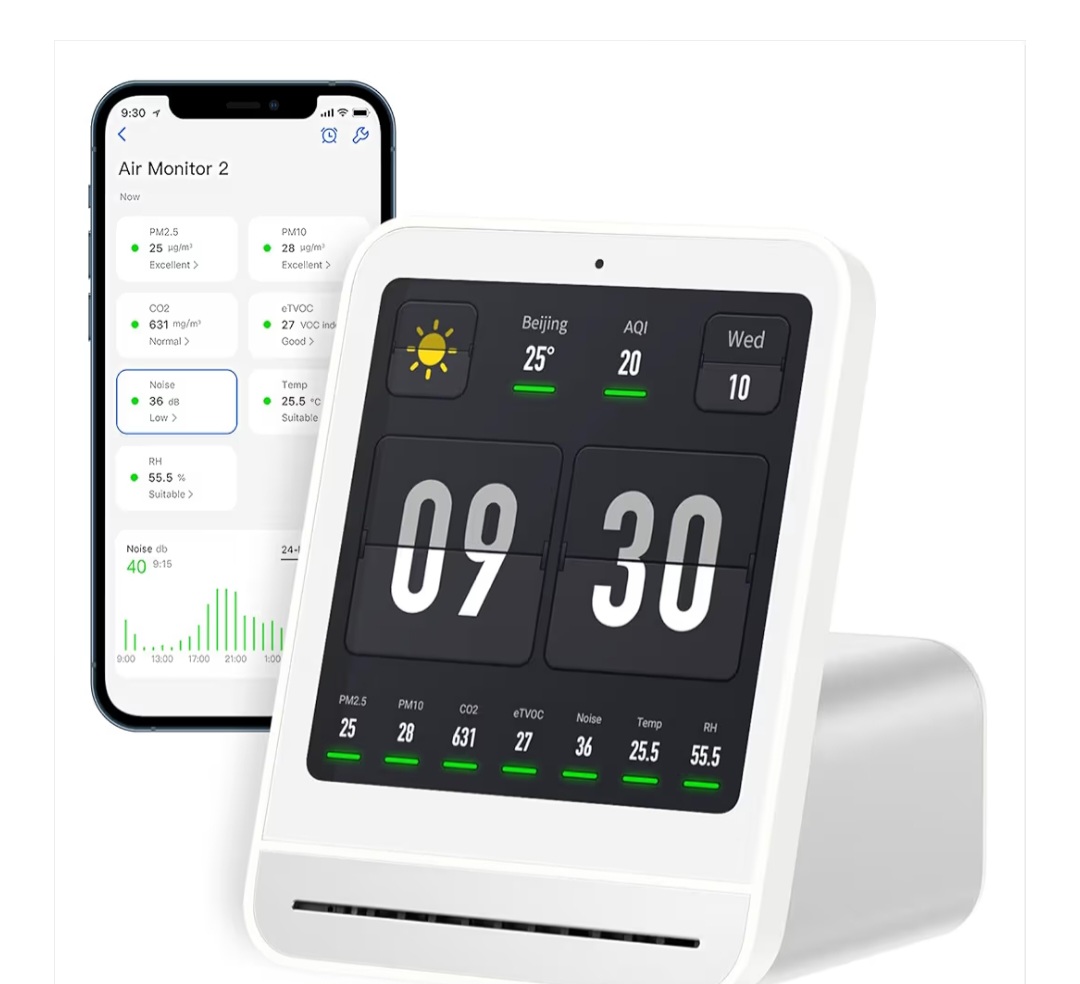
I have used Qingping Air Quality Monitor since 2022 and I leave it plugged in all of the time since it works best if it is continuously monitoring. It is also a bedside alarm clock with touchscreen.
The Qingping Air Quality Monitor 2 provides real-time monitoring of 7 metrics, including temperature, humidity, CO2, PM2.5, PM10, TVOC and noise level.
What can you do about your indoor air quality?
- Get an air quality monitor.
- Open the windows for fresh air daily.
- Use a fan to vent in fresh air or exhaust out old air daily.
- Run exhaust fans in the kitchen, bathroom, or HVAC system.
- Buy a carbon filter, HEPA filter air purifier that is upgraded to remove vocs.
Regular HEPA filters won’t remove VOCs, but an activated carbon filter removes VOCs. Read more on this here:
Best HEPA Filters with Activated Carbon Filters to Remove VOCs
- Get clean air plants like: orchids, snake plants, and peace lilies. More info on indoor plants here: Biohack Health With Indoor Plants + Easy to Care For Indoor Plants
- Sometimes running the Air Conditioning can help lower high indoor humidity along with getting a dehumidifier
Amazon Referral Link for Dehumidifier.
- Storing shoes in a box, closet, or shoe cabinet keeps their VOCs a bit more contained than in your airspace.
- Closing closet doors helps keep your airspace cleaner because the items are not off-gassing into your breathing space.
- Declutter extra items. Purge and donate. Fewer items means fewer chemicals off-gassing.
- Store items away from your bedroom if possible so you can enjoy cleaner air while you sleep (since sleeping is 6-9 hours of your time breathing).
- Mattresses, sheets, rugs, and shower curtains all have alternative versions that off-gas less. Look for EVA or PEVA plastics (EVA is best), organic cotton, wool, bamboo fabrics, PVC free plastics and products that say “greener/safer chemicals.”
- Purchase clothing that says it is eco-friendly and uses “safer” chemicals sometimes helps, but off-gasing can increase depending on the materials used and dyes. Rubbers and glues off-gas.
What makes indoor air quality worse so you can prevent it? What is measured on an air quality monitor?
Indoor air quality can worsen if humidity is high over 60% or low, under 40%. Most air quality monitors check indoor humidity.
CO2 rises when doors and windows are shut. Humans emit our own VOCs when we breathe and release CO2. This builds up when we sleep especially of the room is small and doors and windows are closed.
Pm2.5 is another variable that is measured in outdoor and indoor air quality monitors.
Pm2.5 are particles that are harmful to our lungs because they can get trapped in our lungs and can harm unborn babies, increase risk of heart disease from prolonged exposure, and irritate asthma.
PM2.5 are created by “combustion of gasoline, oil, diesel fuel or wood” so mostly come from burning wood or candles indoors, and can get into your house if the outdoor air quality is poor.
Benefits of Improving Your Indoor Air Quality:
Improving your indoor air quality is a helpful biohack for improving your health. You will improve your sleep and can reduce headaches and prevent other health complications that can be caused by poor indoor air quality.
Another benefit of improving your indoor air is a reduced spread of colds and flu viruses due to more ventilation and using a HEPA filter with activated carbon (must be a filter upgraded to remove vocs in order to be effective). HEPA filters remove germs (cold and flu) from the air.
It is a deliberate, science‑based way to optimize your body’s health, energy, and performance by changing your environment when you take charge of your indoor air quality.
To find out how to clean your air, read my article about air purifiers, HEPA filters with activated carbon filters (link below).
https://inspiredself.blog/what-is-a-hepa-filter-and-what-kinds-of-air-purifiers-remove-vocs/
Sources:
https://ww2.arb.ca.gov/resources/inhalable-particulate-matter-and-health


This article is very beneficial i truly recommend people , should read this Blog , reality and health is more important now days. Mostly in winter arcs – The doors are closed because of cold air , but what happen inside of the door that every understand(headaches, Cold, Illness , sick moment) but no one can stepped from that because few people knows about this “Air Quality” – pros and cons, process, effected disease by this .
Truly i am personally don’t know about the “What is TVOC?” and “Pm2.5”. Today I gain the knowledge from this blog and i want to say please write a blog about the “HEPA purifiers” what you already wrote in this blog.
Thanks for sharing,
Vibek Pradhan