Sun. Jan 11th, 2026

December 2025

Music Artist/Actress/Model Monet Anais Shares Her Tips on Building Your Own Brand and Following Your Passion

Today Inspired Self Blog is featuring a singer, actress, songwriter, entrepreneur who is sharing with us her passion and tips in our Q&A on building your own brand and following your own passion.

Monét Anaïs is a dynamic artist whose creativity moves across music, acting, modeling, and screenwriting. A natural storyteller from Orange County, CA, she began performing at three, wrote and directed her first film at ten, and by thirteen was recording in studios for projects like Kids Bopz. After graduating from Loyola Marymount University, she stepped into her solo career with early releases like her singles such as “Unconditional Love” and “Light It Up,” signaling the determination and range that continue to define her work today.

Creative Identity & Passion

  1. What first sparked your passion for music, acting, and producing—and how did you know it was your path?

Monét Anaïs: When I was little, I began performing on stage at age 3, taking dance classes, and participating in recitals. I knew I loved to sing & dance, and be in front of the camera. As a kid, you wonder what you’ll be when you’re older. I thought I might be a surgeon like my aunt or a doctor of some sort. However, it was music and the arts that drew me in. At age 10 I was writing my first screenplay and my parents helped me develop it into a film. I knew then what I was capable of and continued on the path ever since.

  1. How do you stay connected to your creative voice while building a media empire?

Monét: I give my mind the freedom to expand on ideas and try new things. I used to be the person who would be out and about 24/7, not taking time to be with myself. Looking back, I was so busy and distracted that my creative brain couldn’t focus or do much. I would even be stumped at times trying to write songs. The pandemic forced me to slow down, and once I slowed down and began to take care of myself more, I was much more in tune with my creative voice. As I work in media and build brand identities for people, these three things are what help me stay connected to my creativity: journaling, meditation, and practicing solitude.

  1. What inspires you?

Monét:

People inspire me. Stories inspire me. Life is never certain, and that’s the beauty of it. This world is full of possibilities and can be used to our advantage for growth.

Motivation & Mindset

  1. What keeps you motivated?

Monét: My dreams, my ideas keep me motivated! 

Takeaway tips for readers: Find what inspires you. Find your why and it will be your motivation and fuel for your passion. Big goals are inspiring and give you momentum. Your goals should excite you and motivate you.

  1. How do you protect your energy and emotional bandwidth while staying visible online?  

Monét: For years, I’ve heard my online mentors, such as Mel Robbins, Will Packer, or Les Brown talk about practicing gratitude and the impact it can have on your life. This is not something I’m consistent with, to be honest. However, when I do it, it immediately puts me in a better mood and changes my mindset for the day. Especially if I’m going through something, I’ll make sure to focus on the positive things.

  1. What advice would you give to someone trying to turn their passion into a platform?

Monét: Do research – See who has done what you want to do or look at people currently doing it.

Write down all your ideas – Take what they’re doing and put your own spin on it!

Execute – Write down every task that must be done to accomplish your goal and split them up, completing 1-2 tasks per day. The movement will begin.

Even if you feel like you’re not moving, but you’re doing these things, trust me, you are.

Empire Building & Strategy

  1. What does building a social media empire mean to you and what does your day-to-day look like?

Monét Anaïs: Building a social media empire is another great way to say “building a brand”! 

It’s figuring out your brand: What does the brand look like, aesthetically, and to outsiders who view your pages?

Its figuring out your niche: Is it understandable and relatable?

Building the empire is showing who you are as a person or the company and for it to be recognizable to anyone who comes into contact with you.

My days look different on the daily. One day will be specifically for my personal brand – so on this day maybe I’m in the studio or at a shoot. Another day I’m working on a client’s brand creating and scheduling out their content. On a different day, I’ll be researching and reporting news for the media or executing press releases.

Each day is something new and I just enjoy every minute of it.

How do you balance being a performer with being a strategist and entrepreneur?

Monét: This is not easy and I’m not sure I really balance well haha! I have ADHD, possibly AuDHD, and I’m still learning myself and what works best for me.

As an entrepreneur, I don’t have or need anyone telling me what to do, I’m managing myself.

So I use all the calendars and task lists I can get my hands on.

Then I also focus on my health because without physical and mental well-being I crash.

So each morning part of my routine is moving my body, yoga or light pilates, going on a walk, drinking water and tea, listening to classical music, things that make me feel good. When I feel good then I can manage life and go about my day.

What’s one lesson you’ve learned about growing your audience while staying true to yourself?

Monét: I’ve realized the key isn’t to copy anyone and simply be myself. Authenticity and being genuine is what draws people in. Allow them to get to know you.

Inspired Self Blog: Self care is important when following your passion and building a brand. Solitude gives you the time to plan and be creative. Your uniqueness is what attracts an audience because viewers want to see your lifestyle, creativity, and the expression of you. Being your authentic self helps you build your audience.

What is your next project (or something you are excited to announce) and what are you looking forward to? 

Monét: I’m looking forward to releasing new music in the new year including my next single “Drunk On U”. As well as a web-series “Monet Goes To LA”, my first professional show.

I just released Christmas music as well, available on all music streaming platforms! Check out Monét’s Latest Christmas song at: https://youtu.be/FWAOTIk-cps?si=jviQBWhxb3rfHMzq

See more links to her music below

Creative Work & Visibility

How can readers support your work—where can they find your latest singles, projects, or collaborations?

Find Monét Anaïs on:

TikTok @monetanais

Instagram @iammonetanais

Fanstories @missmonet_xo

YouTube @monetanais https://youtube.com/@monetanais?si=7QugF3f-UxsvA8zF

My latest music:

Spotify https://open.spotify.com/artist/3E1tWjq49IxBu7MZfXrz67?si=xeqUW80kQ0OC-uwTnEUFDQ

Tidal https://tidal.com/@monetanais

You can contact Monét Anaïs for her services: modeling, press releases, hosting tv shows, podcast interviews, creating your brand identity, or for article collaborations at

monetanaisofficial@gmail.com

Keep Scrolling to find out more about Monét.

Monét Anaïs is a model, actress, singer, song-writer, and entrepreneur. Her sound blends pop, R&B, Afrobeats, and dance, heard in singles like “Fact of the Matter” and “Down.” Beyond music, she’s developing a growing creative universe that includes her web series “Monét Goes to LA,” new merchandise, and a slate of film and television projects.

Monét’s journey hasn’t been linear. After an early studio opportunity led to the creation of her first holiday recordings, the timing wasn’t right and the music slipped quietly into the world.

What followed was a much-needed break from the spotlight; a period of reflection familiar to many artists navigating how to stand out, sustain themselves, and stay inspired.

That pause reshaped her.

Monét returned with clarity, purpose, and a renewed sense of artistry, embracing both vulnerability and ambition. She has since reintroduced her holiday music with a polished, long-awaited release of “Have Yourself A Merry Little Christmas” and a sultry, modern version of “Baby It’s Cold Outside” featuring her longtime collaborator StaJe.

Today, Monét Anaïs is carving her space as one of the most versatile and determined rising creators of her generation, building a body of work that spans sound, story, and screen, and continuing to grow a brand that reflects exactly who she is: bold, heartfelt, and impossible to ignore.

Biohack Your Life By Improving Indoor Air Quality in Your Home and Bedroom

Why Your Indoor Air Quality Matters and How it Effects Your Health and Sleep

I did not know how bad my indoor air quality was til I was sick and sleeping with the windows and bedroom door shut for a week and had headaches and too exhausted to wake up.
My fiancé said the air was terrible like death in my room. I was offended. I also thought maybe he is right. I looked up how indoor air can cause headaches and make you feel worse and more tired. I wasn’t getting healthier. I stayed sick and tired. I ordered an air quality monitor off amazon. I had heard about vocs and did not really know much about them at the time. I started researching.
The air quality monitor showed over 1000 tvoc in my room which is extremely terrible for your health.
What are vocs (tvoc)?
Vocs are volatile organic compounds that “off gas” from household items like rugs, furniture, paint, chemicals, air fresheners, perfumes, candles, clothing, shoes, and electronics (basically everything) and even plant soil off gases a bit. It creates a gas that accumulates indoors and can cause headaches, irritate asthma type symptoms, sleep disturbances, and eyes, nose, and throat irritations, nausea, and dizziness and contributes to indoor air pollution.
According to Epa.gov, vocs can contain harmful “chemicals such as:
Benzene
Formaldehyde
Toluene
Xylene
Dichlorobenzene
Acetone
Terpenes
These chemicals are released as gases, “off-gassing” when the products are used or even just stored in your house.”
I found that having more items in your house means higher vocs. Every single item let’s off its own off gasing unless you get bamboo sheets, specific glue free type rugs that are hand woven with dye free wool yarn etc. The common household items or clothing, athletic shoes, etc all off gas a little and some are extreme. I noticed the vocs climb on my air quality monitor as soon as I close the windows and that shows my household items are off gasing.
As an amazon associate, I earn from qualifying purchases.
Get my Air Quality Monitor Here:
https://amzn.to/4pvA8LU
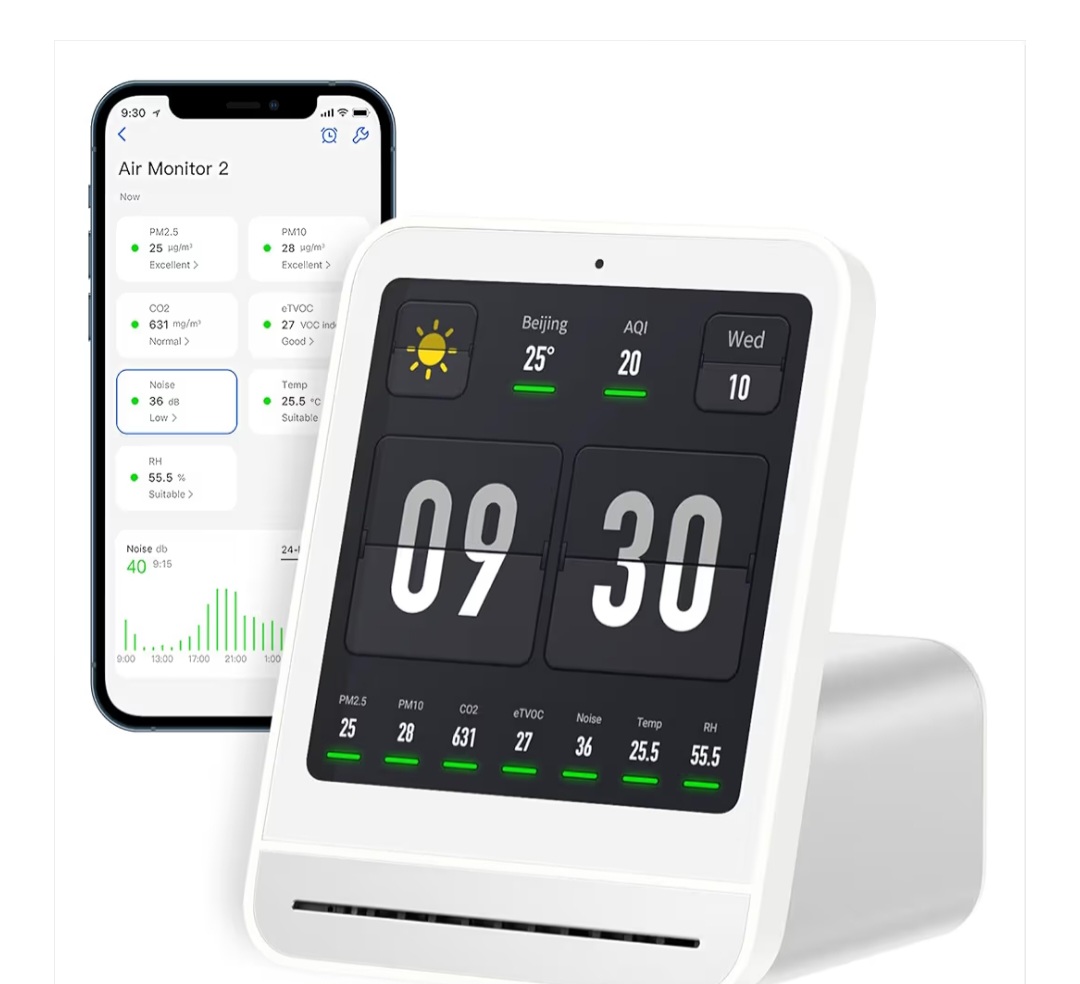
I have used Qingping Air Quality Monitor since 2022 and I leave it plugged in all of the time since it works best if it is continuously monitoring. It is also a bedside alarm clock with touchscreen.
The Qingping Air Quality Monitor 2 provides real-time monitoring of 7 metrics, including temperature, humidity, CO2, PM2.5, PM10, eTVOC and noise level.
What can you do about your indoor air quality?
1. Get an air quality monitor
2. Open the windows for fresh air
3. Use a fan to vent in fresh air or exhaust out old air daily
4. Run exhaust fans
5. Buy a carbon filter HEPA filter air purifier that is upgraded to remove vocs. Regular HEPA filters won’t remove vocs. *more on this to come
6. Get clean air plants like: orchids, snake plants, and peace lilies
7. Sometimes running the Air Conditioning can help lower high indoor humidity along with getting a dehumidifier
8. Storing shoes in a box, closet, or shoe cabinet keeps their vocs a bit more contained than in your airspace.
9. Closing closet doors helps keep your airspace cleaner.
10. Declutter extra items. Purge and donate. Fewer items means fewer chemicals of gasing.
11. Store items away from your bedroom if possible so you can enjoy cleaner air while you sleep (since sleeping is 6-9 hours of your time breathing).
12. Mattresses, sheets, rugs, and shower curtains all have alternative versions that off gas less. Look for organic cotton, wool, bamboo fabrics, PEPA free plastics and products that say “greener/safer chemicals.”
13. Purchase clothing that says it is eco-friendly and uses “safer” chemicals sometomes helps, but depends on if the materials. Rubbers and glues off gas.
What makes indoor air quality worse so you can prevent it? What is measured on an air quality monitor?
Indoor air quality can worsen if humidity is high over 60% or low, under 40%. Most air quality monitors check indoor humidity.
CO2 rises when doors and windows are shut. Humans emit our own vocs when we breathe and release CO2. This builds up when we sleep especially of the room is small and doors and windows are closed.
Pm2.5 is another variable that is measured in outdoor and indoor air quality monitors. Pm2.5 are particles that are harmful to our lungs because they can get trapped in our lungs and can lead to harm to unborn babies, heart disease from prolonged exposure, and asthma. They are created by “combustion of gasoline, oil, diesel fuel or wood” so mostly come from burning wood or candles indoors and can get into your house if the outdoor air quality is poor.
Benefits of Improving Your Indoor Air Quality:
Improving your indoor air quality is a helpful biohack. You will improve your sleep and can reduce headaches and prevent other health complications that can be caused by poor indoor air quality. Another benefit is, more ventilation and using a HEPA filter with activated carbon (must be a filter upgraded to remove vocs in order to be effective) can also prevent the spread of the flu and colds. It is a deliberate, science‑based way to optimize your body’s health, energy, and performance by changing your environment when you take charge of your indoor air quality.
Read my article about air purifiers like HEPA filters with activated carbon filters, *coming soon.
Sources:
Facebook
Twitter
LinkedIn

Transforming Pain and Suffering and Understanding Those With Chronic Illness or Chronic Pain

Most people do not realize that pain and/chronic illness has two layers: the pain itself, and the loneliness that chronic pain/illness brings.
Is there a purpose of Pain and Suffering? Is there a purpose for it?
How can we turn our Pain and Suffering into meaning that better serves us and others?
This article may help someone transform their pain into a deeper meaning.
The goal of the article is not to educate everyone on all illnesses or offer solutions, but to offer understanding of what chronic pain and illnesses may be like so you can better support your family, friends, and community.
Possible Deeper Purposes of Your Suffering:
1. Empathy Expansion
This week I had 2 ER visits and it inspired me to talk about this topic. After being sick in the hospital on and off when I was in my 20s and 30s due to severe anaphylaxis (allergic reactions) and having to navigate my health, it taught me how to understand the struggle my Grandmother was going through when she explained to me that she had Parkinson’s Disease (understanding the depth of it really unfolded over time). I used to not know what it was like to struggle or suffer or go to scary appointments so if someone said something, I wouldn’t understand or know what to say.
I think many people who haven’t experienced hospital visits and tests would not really know what to say or think. The experiences I had allowed me to be there for my Grandmother and also comfort her in ways I wouldn’t know she needed if I had not been through some things myself.
It is important to not invalidate someone when they tell you something about their health or pain. For example, “You will be fine,” or “It is not that bad…”or “At least you ____ or don’t ____.” Being silent or ignoring what they said is also invalidating. Some people change the subject.
From the perspective of the person sharing, silence can convey a lack of care, interest, or empathy, making them feel unseen and their experience dismissed. This lack of acknowledgment can be deeply hurtful, especially during or after a difficult health situation when support is needed most. A simple acknowledgment like, “I’m sorry to hear that; I hope you are doing okay,” can make a significant difference in making someone feel heard and valued.
Some of the validating responses are:
“I can see that this is a lot to deal with.”
Legitimizing: “Your symptoms are real, even if the tests don’t explain them yet.”
Empathy: “That sounds uncomfortable and frustrating. I understand why you’d be concerned.”
Supportive curiosity: “Tell me more about when this happens so I can understand better.”
Partnership: “Let’s track this together so we can give your provider a clear picture.”
Respecting effort: “You’ve done a lot of work to monitor this.”
Safety‑anchored: “If it feels worse or changes suddenly, it’s important to reach out right away.”
After having chronic pain the last few years too, I realized suffering helped me have an idea of the isolation chronic pain can cause. I also met a technician at a CT Scan whose brother has Chron’s Disease and his brother went on to be a Gastroenterologist to help others with the same condition he has. We were talking about how isolating illnesses can be and it is hard to even tell someone the struggle and often, they don’t understand. No one wants a food restriction so if they mention they cannot eat something, it is likely for a good reason.
Try to see how any pain you had or a failure, a loss can have meaning and help you understand others. How can it help you respond to others who are suffering? Sometimes giving a deeper meaning to the pain is helpful because it feels the pain was not in vain or senseless. Turning pain intro transformation can benefit anyone whether you suffered a loss of a job or if you suffer from a chronic illness. Especially because chronic pain and illness feel so out of control. When we give meaning to our suffering, it can help us manage the loss we feel.
When we receive validating support from someone, it can make us truly feel seen and relieve some of the burden.
Illness, pain, injuries, etc can lead to judgment. People assume you did something to cause it and it is your fault. It leads to misunderstanding and isolation. That’s a different kind of suffering.
Understanding suffering can deepen compassion for others who feel unseen.
People with chronic pain, illnesses, and injuries most often did not do anything to cause it. There’s genes…a healthy diet does not cure everything. Exercising does not fix every problem. Accidents happen.
What if suffering isn’t a dead end, but a doorway into a version of yourseld that sees the world more clearly, more deeply, and more compassionately?
2. Resilience & Identity Shift
Online content mentions manifesting even in a way that places blame on a sick person as though they “manifested it.” Then we want to be better and not the “sick version” of ourselves and anchoring a “well version,” but ignoring actual physical issues or symptoms is dangerous.
Physical suffering forces you to set new boundaries and author clarity about who you are beyond illness. It’s not about glorifying pain, but about recognizing how it reshapes identity. Identifying with an illness can lead to a cycle perpetuating more illness. The mind has power. Ignoring illness is also not a cure.
Symptoms, pain and illness are data to tell you something is wrong, needs, change, correction, or even that your mind needs stress reduction to help in healing. Often medications are an aid and some see them as a crutch, but some are necessary for someone to live. There is misunderstanding and stigma associated with illness and medications.
Chronic illness and chronic pain can lead to having to change careers, stop working, and identity shifts. This is much to go through…to lose a fit body, abilities, appearance, career and pay, etc. These losses cause grief. Not all grief is caused by death or losing someone.
After losing my identity as a long distance, sponsored runner and musician, I had to find new interests, hobbies, and identities.
Identity and self-concept is something we as humans tend to create whether we mean to or not. It is part of the psychology of survival and helps the brain do automatic processes that aid in survival and habits. Habits are much easier than will-power and are created subconsciously, but other habits can be created intentionally. Our brains naturally make habit loops in order to save energy and willpower takes more energy than a habit. That is why we develop a self concept…it is partially due to habits, the brain preserving energy, and due to social programming that occurs as soon as we are born and receive a name. When we say we are a parent, that is an identity. When we are a runner or have a specific career, that is an identity.
With chronic pain and illness, you may lose your identity and it is important to make a new identity that makes you happy and proud. It will better serve you to have a new self-concept than to stay in grief. The future may hold recovery and the possibility of returning to old identities you desire too.
3. Humility Without Collapse
Terrible pain and illness is humbling. You look at others’ struggling after you experienced it yourself. Seeing people who cannot walk or run has a different lense after you realize the struggle it is to get dressed, go outside, or even look for anything in your house and a whole long list of things you cannot do when you have extreme pain. When you are not well, it takes all of your energy to go somewhere and to get reduced pain from medications enough to last a couple of hours. You may suffer silently in pain around others just to attend coffee or a dr appointment. It gives a humility, when paired with strength, that can be the difference being between broken down and being refined. You respect others and their struggles and recognize there are silent struggles and people who appear fine physically, but are struggling too.
4. Signal vs. Judgement
  You can treat suffering as data, not as a verdict. Symptoms and pain are data and signals. Signals can lead to solutions and problem solving. The deeper purpose of suffering may be to model a new way of engaging with illness: one that honors signals instead of internalizing judgements and looking for new solutions. Even trying new solutions can help you become more open-minded and you may see how one thing does not work for everyone. It gives you respect for yourself…for all you go through and also for all your body does for you and realizing you want to give your body the best.
You may experience judgements, but know who you were and are, and know that people simply do not understand. Many doctors may jump to judgements and conclusions and this can take you awhile to find cures, the diagnosis, etc if things are overlooked. Asking questions and requesting tests helps. Seeking a second opinion is best to not delay recovery.
For those trying to understand, asking your friends and family questions about their condition or day-to-day experience can help you get a better picture of what they are going through. You could look up how to better support someone going through an illness so you can be an ear, just be there for them, or know what to say. This prevents accidentally shrugging off something they are going through which can lead them to feel isolated.
It is hard to have no one know what you go through or how bad it is and no one to tell. Then when you do tell, to not be understood.
If you get a therapist, make sure they specialize in therapy for someone with chronic illness or they may make more judgements by accident and not be able to help. Some may say they have experience in therapy for someone with chronic pain, but make sure they truly are trained and specialize in it. A mental health practitioner has an is important job to help you stay safe and if they are not trained and understanding, it can lead to dangerous consequences.
5. Finding Alternatives to Your Previous Activities
Being judged by others and therapists reopening wounds by talking about past and current pain was not helpful to my healing. It taught me that reexperiencing emotional pain keeps you suffering the same wounds. It has been best for me to process pain and find forward action steps to let go and action steps towards healing. It helped me to focus on seeking joy and finding new things I can do. Through my chronic pain (I can no longer run daily), I focused on my mind…books, content, learning new skills all helped me during a rough time I had physically. New, non-physical hobbies really helped me when I struggled the most.
You can prioritize boundaries with others about their judgements and take forward action steps towards healing, making it through the day, finding new joy and interests, and solutions.
6. Thoughts to Anchor
Suffering doesn’t always mean you’re being “punished or tested.” Sometimes it’s the raw material for a new narrative: one where you become the person who can hold space for others’ pain without collapsing, and who can model living with authenicity, even when misunderstood.
I truly found it helpful to find ways to turn pain and suffering into a deeper meaning and using it to try to help others. The pain and suffering also taught me lessons and helped me grow. I wrote this hoping others turn their pain and suffering into something that can be managed. For those who do not know pain, to have a better understanding of what family and friends may be going through. Be kind because you do not know how much your kindness helped someone or what someone may be going through.
Pain is often invisible. Your kindness may be the one thing that helps someone carry theirs.

Meaningful Compliments: Why it Levels Up Relationships When You Give Meaningful Compliments and How To Do It

How to compliment friends and family and why is it important to give compliments:

My Dad gave meaningful compliments that made us feel seen, like our efforts mattered, and who we are was noticed. These compliments lasted a lifetime. You never know what a boost your compliment will bring and how it can help someone in their life. He was the only person who told me I looked pretty and senior prom and he said my violin playing sounded professional at my university junior solo recital. These compliments remain long after he gave them and after his life.

How do we give a meaningful compliment?

Try to see the whole person in front of you. Notice what you love about your loved ones and put it to words.

Compliment their efforts and actions.

It does not have to be a long compliment.

Be authentic.

The smallest compliments also matter. Just telling them their “sweater and style is nice” also matters and makes their efforts feel noticed.

Be specific. Say what you liked about their presentation or article, etc.

Notice their character traits and compliment those. You could notice they are always a hard worker and pay attention to detail. Maybe they are always on time or very organized or have unique ideas and even say what idea you like that they have. Let them know.

Notice what they pour their heart into and find something nice to say about their work and passions.

These compliments may be the only nice and positive thing the person heard in weeks. The meaningful compliment can give them the boost they need to keep going in a hard project, feel loved, and thrive. It makes you valuable to your friends and families when you are giving them meaningful words.

Some examples of shallow compliments are “I liked your presentation” or “Nice shirt.” We can elaborate on the compliment to make it more effective. Say one thing you liked that was brought up on the presentation. Say why you like the shirt and maybe it is a good color on the person or flatters their frame or personal style.

Relationships in life help us live longer and strong connections support us.

Giving compliments will help build connections and making lasting impressions in someone’s life.

You do not realize the impact your words may have on someone whether they be negative or positive. Positive and meaningful compliments can truly fuel someone’s life and build self-belief.

In conclusion, meaningful compliments can boost self esteem, connection, and the resilience of the receiver.

People may think back on your compliment that gives them what they need to believe in themselves and keep going on a tough project or goal.

I dedicate this article to my Dad who would have been 64 years old today. I miss him and his compliments and he was one of the only people that made me feel truly seen and appreciated for who I am. His meaningful compliments and attention to detail made him irreplaceable to me.

Your meaningful compliments and noticing your friends and families are a deeper level will make you memorable and irreplaceable to them too.

Give it a go and practice giving meaningful compliments and giving compliments will eventually come naturally to you.